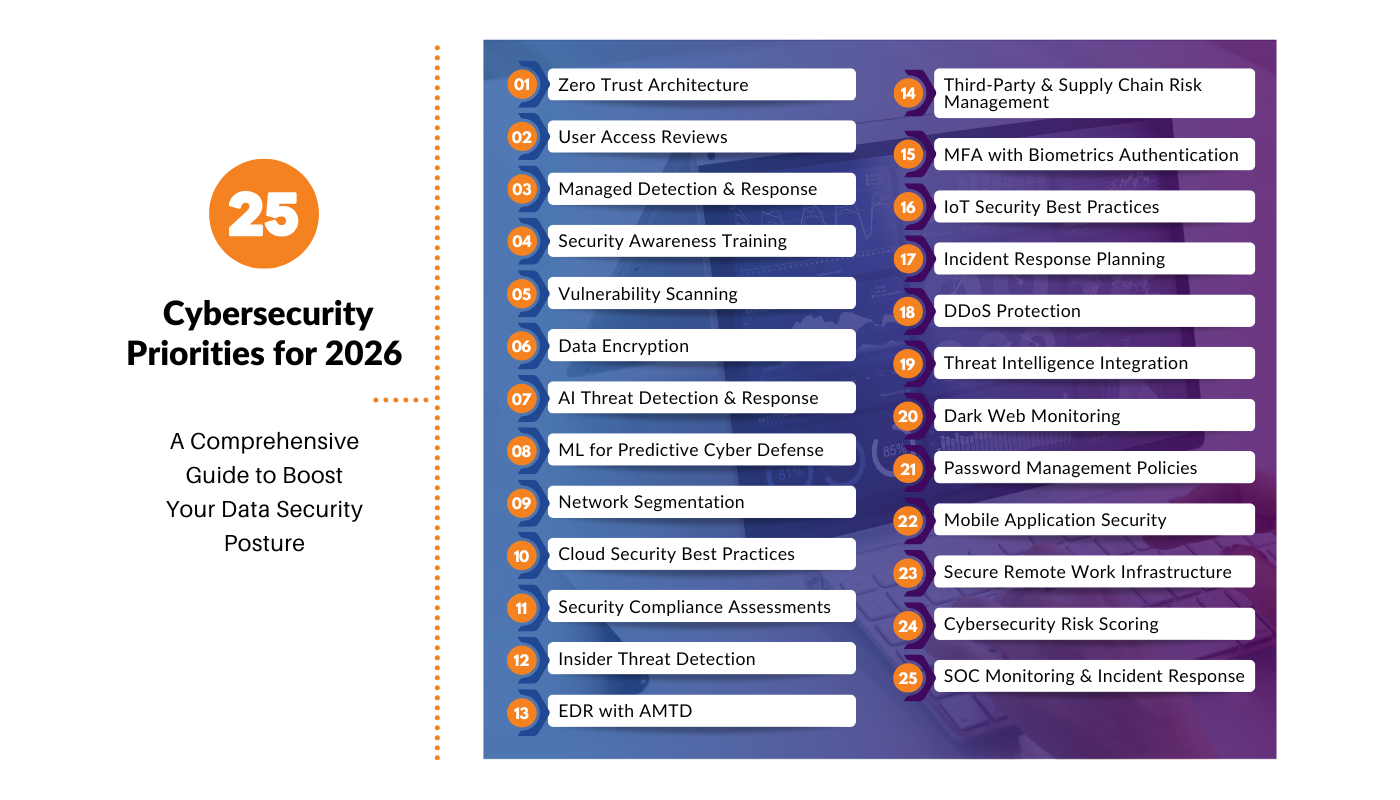
Cybersecurity incidents now escalate in hours, not weeks, as attackers exploit identity gaps, trusted relationships, and operational blind spots — making ransomware, token theft, and data exposure symptoms of environments too complex to defend reactively. In 2026, security leaders must manage ransomware, supply chain risk, identity-based attacks, and AI-enabled phishing under tighter budgets and scrutiny, making the 25 cybersecurity priorities below essential for reducing risk and strengthening resilience.
1. Zero Trust Architecture
Adopt a zero-trust framework: never trust, always verify. Rather than relying on a single perimeter, zero trust treats every access attempt as a potential breach, continuously validating users, devices, and actions. Access is restricted by default, while continuous monitoring and segmentation limit exposure around critical systems and data.
2. User Access Reviews
Regular access reviews reinforce the principle of least privilege and reduce unauthorized access. In 2026, access governance must extend beyond human users to include service accounts, APIs, and other non-human identities, with a focus on removing stale access and excessive privileges.
3. Managed Detection & Response
Eliminate the challenges of building and staffing a security team with managed detection and response (MDR). Beyond traditional SIEM alerting, MDR provides continuous monitoring and active response, helping contain and neutralize threats before they escalate into business-impacting incidents.
4. Security Awareness Training
Strengthen your first line of defense with a strategic security awareness program. Move beyond static training and engage users with realistic scenarios and hands-on phishing simulations. Equip employees to recognize phishing red flags, report suspicious activity, and adapt as AI-driven phishing becomes more targeted and convincing.
5. Vulnerability Scanning
Regular vulnerability scanning helps identify weaknesses across systems and applications before attackers can exploit them. A proactive vulnerability management strategy strengthens security posture while supporting regulatory compliance and cyber liability insurance requirements.
6. Data Encryption
Protect sensitive information with strong encryption at rest and in transit. Encryption ensures that even if unauthorized access occurs, exposed data remains unreadable and unusable without the appropriate keys.
7. AI-Driven Threat Detection & Response
AI now plays a central role in threat detection and response by identifying suspicious behavior, reducing alert fatigue, and accelerating response times. By analyzing activity across endpoints, networks, cloud environments, and identities, AI improves visibility into threats traditional tools may miss. Organizations continue to report better detection accuracy and response efficiency when AI is paired with human expertise (IBM).
Effective AI-driven security requires human oversight and governance. Continuous tuning, validation, and contextual review help ensure automated decisions remain accurate, explainable, and aligned with organizational risk.
8. Machine Learning for Predictive Cyber Defense
Machine learning (ML) supports a more proactive security posture by identifying anomalies and early indicators of compromise. By analyzing behavior over time, ML helps teams detect emerging threats earlier and improve threat intelligence capabilities (IBM).
Ongoing monitoring and governance are essential to prevent model drift and maintain reliable, relevant predictive insights.
9. Network Segmentation
Segment networks to limit lateral movement and reduce the blast radius of potential breaches. Segmentation allows security controls to be applied based on system sensitivity and business risk.
10. Cloud Security Best Practices
Secure cloud environments by enforcing strong access controls, encryption, regular audits, and continuous monitoring. Certain industries, including local government, must also meet specific requirements such as CJIS compliance.
11. Cybersecurity Compliance Assessments
Regularly assess and demonstrate compliance with cybersecurity regulations and standards. For organizations operating in environments with limited tolerance for downtime, data loss, or control failures, regular compliance assessments help demonstrate due diligence while strengthening overall security posture.
12. Insider Threat Detection
Insider threats — intentional or accidental — remain a significant risk. Monitoring user behavior and detecting anomalies enables faster response and limits potential damage.
13. EDR with Automated Moving Target Defense
Enhance endpoint detection and response (EDR) with automated moving target defense (AMTD). By continually shifting the attack surface, AMTD disrupts reconnaissance and exploitation while improving endpoint resilience.
14. Third-Party & Supply Chain Risk Management
Reduce third-party and supply chain risk through disciplined patching, access controls, and continuous monitoring. Unmanaged SaaS integrations, over-privileged vendors, and unpatched software remain common entry points for attackers.
15. Multi-Factor Authentication with Biometrics
Strengthen identity assurance by incorporating biometrics into multi-factor authentication (MFA). In 2026, prioritize phishing-resistant MFA and reduce exposure to social engineering and MFA fatigue attacks through tighter controls and smarter prompts.
16. IoT Security Best Practices
Treat IoT and operational technology (OT) as core security domains. Reduce risk by enforcing device identity, segmentation, firmware updates, and continuous monitoring.
17. Incident Response Planning
Test and refine incident response planning through red team exercises and realistic simulations to ensure teams can respond effectively under pressure.
18. DDoS Protection
Defend against Distributed Denial of Service (DDoS) attacks to maintain service availability during sustained attack attempts. Effective DDoS protection helps prevent outages that can disrupt operations, erode customer trust, and mask secondary attack activity.
19. Automated Threat Intelligence Integration
Use automated threat intelligence to adapt defenses quickly as attacker tactics evolve. Timely intelligence enables security teams to prioritize alerts, tune controls, and respond more effectively to emerging threats.
20. Dark Web Monitoring
Monitor the dark web to identify exposed credentials and emerging threats before they are exploited. Early visibility into compromised data supports faster remediation and reduces the likelihood of follow-on attacks.
21. Password Management Policies
Strengthen credential security with strong password management policies and centralized enterprise password management (EPM). Monitor for credential exposure, reduce reuse, and prioritize phishing-resistant authentication where possible.
22. Mobile Application Security
Protect mobile applications and data as mobile usage and hybrid work continue to expand. Secure development practices and runtime protections help reduce exposure to data leakage, unauthorized access, and malicious app behavior.
23. Secure Remote Work Infrastructure
Create a secure remote work infrastructure that is identity-first and resilient to compromised devices and unsafe networks.
24. Cybersecurity Risk Scoring
Use risk scoring to prioritize threats, correlate vulnerabilities to financial impact, and guide security investment decisions. Quantifying risk helps security leaders focus resources where they will reduce exposure most effectively.
25. 24×7 SOC Monitoring & Incident Response
Leverage an outsourced Security Operations Center (SOC) to provide continuous monitoring, detection, and response without the overhead of building an in-house team. A 24×7 SOC improves visibility, shortens response times, and helps contain incidents before they escalate.
PARTNER WITH A TRUSTED MSSP FOR COMPREHENSIVE CYBERSECURITY
Effective cybersecurity in 2026 is less about adding tools and more about executing consistently under pressure. Organizations operating in complex, high-accountability environments need clear visibility across identity, endpoints, cloud, and third parties — and the ability to respond before issues turn into outages, incidents, or business-level consequences.
The priorities outlined here reflect how mature security programs operate today. Omega Systems helps organizations put these controls into practice through coordinated services, continuous monitoring, and an in-house SOC that investigates and responds to real threats in real time.